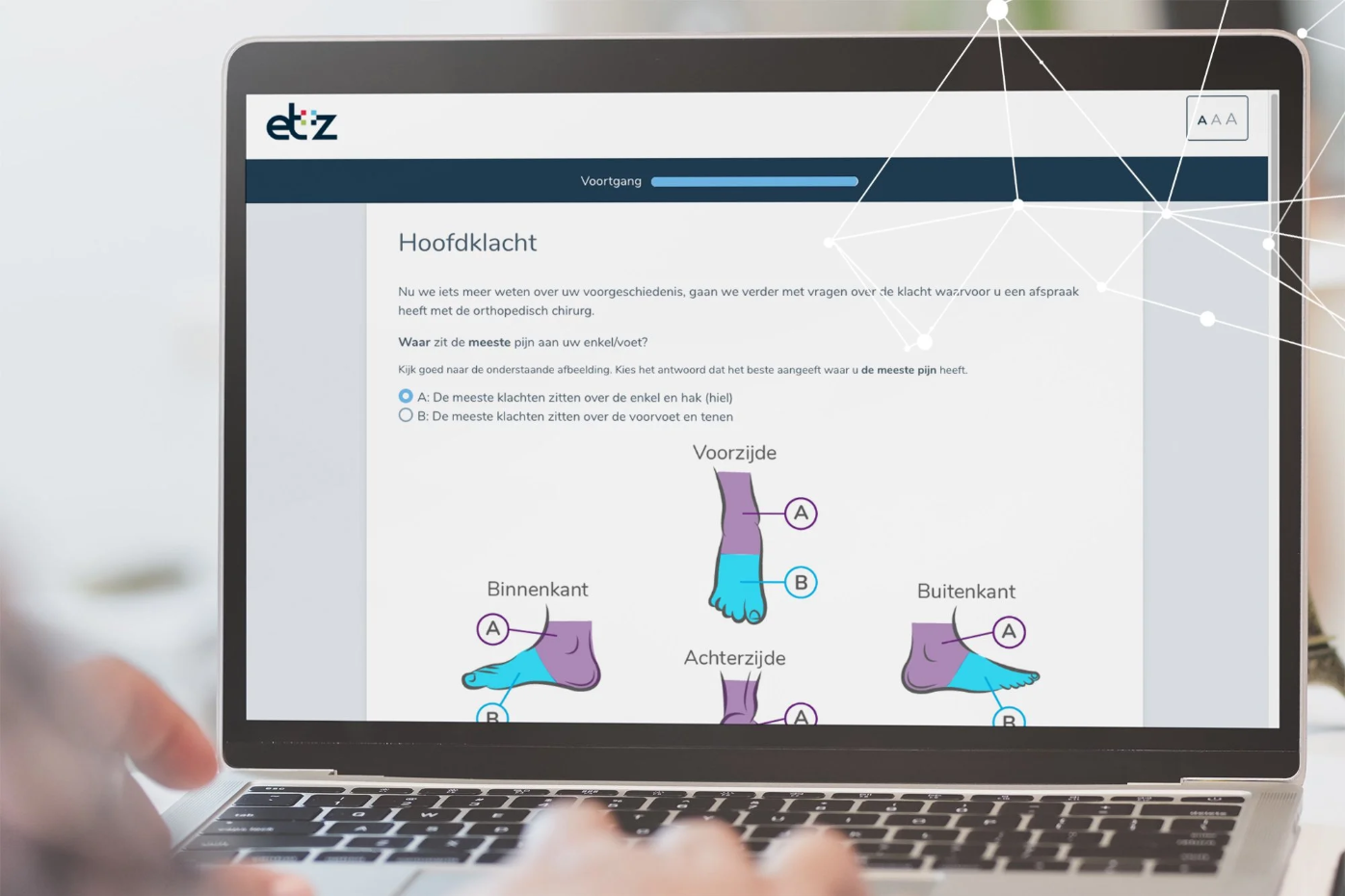
Since early 2022, the orthopaedics department has been using the Orthopaedic intake module from PROMs. The Elisabeth-Tweesteden Hospital (ETZ) has been measuring PROMs using PROMs since 2015.
Carel Diekerhof is an orthopaedic surgeon and medical manager of orthopaedics at the ETZ. Below, he shares his experience with this module.
Carel Diekerhof
What is the Orthopaedic intake module in PROMs?
This module allows patients to complete a digital anamnesis questionnaire at home before their visit to the hospital. A summary of the answers is then displayed directly in the Electronic Patient Record (EPR) so that the healthcare provider can review them during the first consultation.
What was the reason for using the module?
At the initial consultation, healthcare providers often spend a lot of time asking standard questions about, among other things, the complaint, its onset, symptoms, and the impact on daily life, work, sport or hobbies. While these questions are essential, asking them takes a significant amount of time, and they are generally questions that the patient can consider at home.
‘Because patients complete the standard questions at home, we can immediately have more in-depth conversations and get to the core of the problem sooner.’
How does this module contribute to your care?
Patients can take all the time they need to complete the questionnaire. They can do this in their own environment, possibly with the help of a partner or carer. Moreover, the questionnaire allows them to indicate what is important for them to discuss during the consultation.
‘As a doctor, I can see at a glance in the EPR what the patient has filled in at home, so I am better informed before the hospital consultation. During the conversation, I only need to verify a number of elements from the summary, allowing me to focus earlier on what is truly important to the patient.’
There is now even so much information beforehand that, based on the data entered, it can already be determined which patients need which additional examinations.
There is now even so much information beforehand that, based on the data entered, it can already be determined which patients need which additional examinations.
Patient experience in the consultation room
Because the healthcare provider is better informed before the consultation, they can look the patient in the eye more often, and a connection is formed sooner.
I receive feedback from patients that they find it pleasant that they receive more attention than my computer. Normally, I have to enter so much information into the system; that workload has now decreased significantly.
Carel Diekerhof gives an example of this. ‘I recently had a lady sitting opposite me whose questionnaire I had read. I learned that she feels limited while carrying out her hobby of diamond painting. She was surprised that I, as a doctor, asked how her symptoms affect her while doing this hobby. Beyond my medical expertise, I now also have access to other information about the patient. The overall picture now emerges much more clearly.’
According to Carel Diekerhof, patients react extremely positively to this new intake procedure. ‘This procedure also makes perfect sense to me. If I want to take out insurance or file my tax return, I also have to enter data first. That determines which service suits me best. In our case that means determining which care or healthcare provider is best suited to this patient.’
I receive feedback from patients that they find it pleasant that they receive more attention than my computer. Normally, I have to enter so much information into the system; that workload has now decreased significantly.
How could we further improve the service in the future?
‘Keep up the good work! Healthcare needs to make a move towards digitalisation if it is to cope with its limited resources. With an increasingly ageing population, we need to help more people with fewer healthcare support staff and less money.’
‘Your service could be improved even further in the future by monitoring the pre- and post-outpatient process. If patients track their progress during this phase, we can offer the right care or healthcare provider when certain threshold values are exceeded.’
‘It would also be good if this questionnaire were rolled out across the whole of the Dutch healthcare sector – or even internationally – so that we can obtain valuable data from patients sooner when they come to our outpatient clinics.’
Would you like more information?
Curious about how PROMs can help you gain more insight and overview when scheduling medical staff? We’d be happy to get in touch with you.
Jeroen Bosch Hospital applies Patient Journey in Preoperative Screening
The Department of Anesthesiology at Jeroen Bosch Hospital (JBZ) has implemented the Patient Journey to make Preoperative Screening (POS) more efficient. Through the Patient Journey app, patients complete a triage questionnaire and receive guidance throughout the entire process leading up to surgery.
Telemonitoring in the region: A collaboration between Rivas & Huisarts en Zorg (HenZ)
AT Rivas and HenZ telemonitoring is used via the Patient Journey app to guide patients remotely. Healthcare providers gain real-time insight into health metrics such as pain scores and blood pressure, allowing them to respond quickly to abnormalities. Patients receive personalized information and are actively involved in their treatment, contributing to better care and increased self-management.
PROMs as a driver of value-based care at Meander Medisch Centrum
Since 2015, Meander Medisch Centrum has been using PROMs (also known as OnlinePROMS) to measure outcomes, improve care processes and strengthen patient-centred care.