Complex planning made simple with Rostering; smart software for effiicient, thrustworty and secure rosters.
Read more
Find out how medical service centres are anticipating developments in healthcare.
Read Altide's story here.Complex duty scheduling, many workstations and high demands on fairness and transparency: Since 2022, the anesthesiology departments of University Medical Center Schleswig‑Holstein (UKSH) have been working with MedSpace—part of Enovation since 2025 and now known as Rostering—to organise their schedules efficiently and future‑proof their operations. The result: significantly less planning effort, greater transparency for staff, and a clear improvement in planning quality.
Prof. dr. Steinfath, director of the Department of Anesthesiology and Intensive Care at University Medical Center Schleswig‑Holstein, Campus Kiel: “Increasing demands on the reliability of duty scheduling led us to the digital solution Rostering in 2022. The initial contact was straightforward and constructive from the very beginning. Our complex requirements for a duty scheduling system could already be met during the first on‑site demonstration through the Rostering solution.”
Prof. dr. Nau, Director of the Department of Anesthesiology and Intensive Care at University Medical Center Schleswig‑Holstein, Campus Lübeck: “Rostering has made the complex planning in our department considerably easier. All relevant parameters are now consolidated on a single interface—providing our staff with greater transparency and saving us a significant amount of planning time. The algorithm‑supported scheduling is a particularly valuable innovation.”
All relevant parameters are now consolidated on a single interface—providing our staff with greater transparency and saving us a significant amount of planning time.
The anesthesiology department at the Kiel campus was the first within UKSH to start using Rostering in 2022. In 2023, the anesthesiology department at the Lübeck campus followed. At both locations, approximately 140 physicians work within the anesthesiology departments. More than 100 workstations and duties must be scheduled correctly and as efficiently as possible across both sites.
A self‑developed solution used in Kiel, combined with Excel, could no longer keep up with the increasing demands of scheduling. Duplicate administration and a lack of feedback loops repeatedly led to double entries and conflicts. Monthly planning, divided among six planners, required approximately two hours per duty group. Annual planning for vacations and intensive care rotations required an additional two full weeks of work. Daily checks for possible double staffing or allocation conflicts between the two planning environments were also necessary. Due to declining data security, an alternative solution was sought.
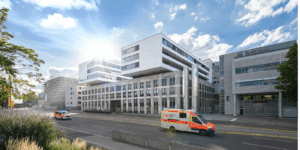
UKSH Campus Kiel
The Department of Anesthesiology and Operative Intensive Care at UKSH Kiel includes the central anesthesia unit with approximately 35 anesthesia workstations, four intensive care units staffed in a three‑shift system, a pain management unit, a palliative care unit, and 8 FTEs in emergency medical services across five locations operating in a two‑shift system.
UKSH Campus Lübeck
The Department of Anesthesiology and Intensive Care at UKSH Lübeck includes the central anesthesia unit with more than 40 anesthesia workstations, four intensive care units in a three‑shift system, a pain center with outpatient clinic and day clinic, three emergency physician bases, tele‑emergency services, and staffing of ITW (Critical Care Transport Unit) and VEF (Inter‑hospital Transfer Vehicle) units within emergency medical services in Lübeck.
Scheduling in anesthesiology is extremely complex, as not only different workstations must be staffed with appropriately qualified personnel, but also a demanding system of on‑call duties and shift work must be organised fairly and with consideration for staff needs.
Under the current conditions, the clinic in Kiel is able to create monthly schedules for all duty groups within two hours. Rostering allows workstation sequences to be configured for up to six months, which can be entered—such as onboarding rotations—with a single click.
Annual planning for all vacations and part‑time arrangements takes approximately four days.
The time saved can be invested in improving planning quality for individual employees, while still leaving additional time for patient care, education, training, and research. This results in a double benefit: satisfied staff and time savings for planners.
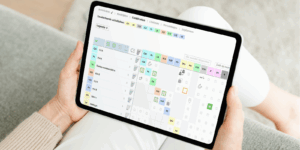
Rostering meets all the requirements we set for a modern duty scheduling system. The app enables staff to access their personal schedules at any time and easily submit preferences and vacation requests.
Prof. dr. Steinfath: “With Rostering, comprehensive and detailed workforce and workstation planning is possible, which is of great benefit to our department with its five sub‑disciplines: anesthesiology, intensive care medicine, emergency medicine, pain management, and palliative care. The specific requirements of different workstations can be mapped in a practical way, enabling efficient and transparent scheduling. Rostering is highly valued by both planners and staff across the various departments.”
The specific requirements of different workstations can be mapped in a practical way, enabling efficient and transparent scheduling.
In addition to the app and the software, we are now beginning to use automated duty scheduling for specific activities. Of particular importance are the minimum staffing levels, which we can define per activity and per cluster and review at a glance. This virtually eliminates over‑ and understaffing.
The integrated reporting system also allows evaluations per employee or per workstation, enabling monitoring of training‑relevant assignments and ensuring the fairest possible distribution.
Our staff use the app regularly—for example, to submit vacation requests and indicate duty preferences.

Since using Rostering, planning time has decreased significantly. The time gained can be invested in improving planning quality and staff satisfaction or used to further increase productivity in anesthesiology, education, and research. Staff feel much more involved in the scheduling process.
In addition, the number of planning errors due to over‑ or understaffing has been reduced to a minimum. The percentage of approved vacation requests has also increased significantly, as it is always clear whether the number and qualification level of staff are sufficient.
Automated rotation planning, integrated with the duty scheduling system, is a highly valuable enhancement. With this functionality, predefined shift sequences can be created and scheduled with just a few clicks. Anyone working with a framework schedule benefits greatly from this innovation. For us, it has significantly simplified annual planning for intensive care and NEF services.
The support department responds quickly to inquiries, says prof. dr. Nau. Emails and phone calls lead promptly to solutions for reported issues. Most problems are resolved during the call itself, with more complex questions addressed within one day.
The software deployment was handled by the support team, enabling us to start planning immediately.
As the largest healthcare provider and the only maximum‑care hospital in Schleswig‑Holstein, and one of Germany’s largest university medical centers, UKSH has high standards for the quality of its work. The anesthesiology departments at both campuses are among the largest specialist departments at UKSH and are characterised by a highly complex work and duty structure.
Rostering is an innovative solution used by more than 650 specialist departments and over 30,000 physicians in the Netherlands, Belgium, and Germany. It is a leading online application for duty scheduling for physicians. Particularly for departments with complex scheduling requirements, Rostering provides the ideal solution for efficient medical workforce planning.
The rostering application was developed twenty years ago in close collaboration with physicians at Diakonessenhuis in Utrecht and Amphia Hospital in Breda and has been continuously improved ever since. Rostering saves time, prevents scheduling conflicts, and increases organisational efficiency—allowing healthcare professionals to focus on delivering high‑quality patient care.
In addition, a mobile app is available that allows users to view their schedule at any time and submit vacation requests, shift swaps, and shift preferences completely digitally. Implementation times are short, and customers can begin using the software within six weeks. 90% of hospitals in the Netherlands trust this digital solution from Enovation.
Want to learn how Rostering can support your organisation with complex duty scheduling? Feel free to contact us for more information.
Contact us
In February 2025, MedSpace became part of Enovation. The digital solution Rostering is now part of the Enovation Platform.
Complex planning made simple with Rostering; smart software for effiicient, thrustworty and secure rosters.
Read more
Dutch hospital Zuyderland improves scheduling with the software solution Rostering. The result? More insight, overview, and control over workforce planning across 21 departments.
Read more
Jeroen Bosch hospital shares schedule changes automatically with the right people. This saves a lot of work and therefore time.
Read more