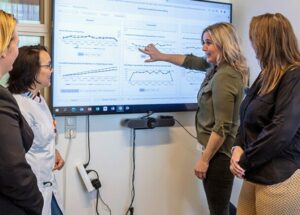
Managing production and capacity, keeping a hold on planning. It certainly is not easy. This is why Flevo Hospital in Almere uses the digital solution Capacity.
Read more
Find out how medical service centres are anticipating developments in healthcare.
Read Altide's story here.The best care, in the right place, at the best time. This might sound logical and self-evident, but it is no mean feat in practice. Balancing bed and staff capacity involves looking ahead and anticipating demand. Close cooperation between different healthcare organisations is required, and this must be based on correct and up-to-date data.
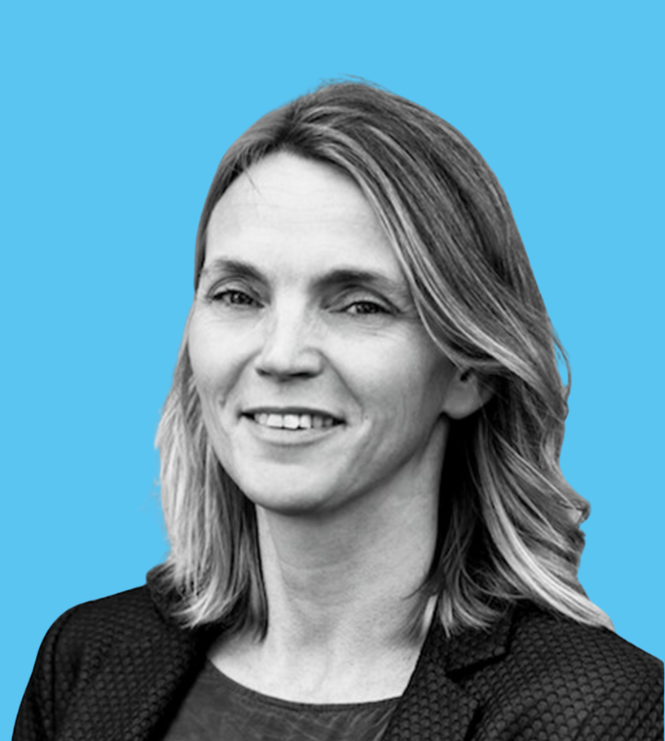
Andrea Poodt | Regioplatform Programme Manager
‘Closer collaboration between different healthcare organisations is one of the keys to continued access to care,’ says Andrea Poodt, programme manager for Regioplatform Noord-Holland, a collaborative network of twelve healthcare organisations; three hospitals, four umbrella organisations of GPs and the five larger nursing, care home and home care (VVT) organisations.
The organisations which collaborate within the Regioplatform have begun by setting up regional integrated capacity management. With transparent data exchange, it is possible to better manage capacity and streamline the flow of patients. This way of working is all about looking ahead. It is about preventing problems instead of solving them.
Closer collaboration between different healthcare organisations is one of the keys to continued access to care.
‘The Regioplatform enables necessary changes to take place,’ explains Andrea Poodt. ‘As a network organisation, we facilitate and encourage collaboration which is focused on innovation, standardisation and digitisation. We initiate and implement projects with the aim of keeping care available and accessible to everyone in Noord-Holland Noord and Zaanstreek-Waterland. Now and in the future. Vulnerable elderly people and those with chronic illnesses receive our particular attention.’
Performation, part of Enovation, is supporting Regioplatform in a project to organise regional capacity management. ‘In many hospitals, capacity management is very professional. But in practice, we often see “congestion” on the other side, because not all patients can go home; some will need home carers, while other patients need to spend time at a recovery clinic or rehabilitation centre. The desired place is not always available at the desired time. This then means that people stay in hospital longer than necessary.’
This has become clear thanks to the ‘chain-wide capacity management’ project facilitated by Regioplatform. ‘First, we want to join forces to do for hospitals and VVT organisations what hospitals currently mainly do in terms of capacity management. Capacity provides the expertise, with knowledge of data and modelling. Setting up capacity management is a process for which Enovation has a wealth of expertise. In other words, how do you ensure that the right conversations are held and customisation is delivered? A model is good, but in reality you still have to make choices.’
The project for which Regioplatform uses the Capacity solution is a pilot focused on CVA patients and clients. A Cerebro Vascular Accident (CVA) can be a brain haemorrhage or a stroke. ‘We chose this group because it enables us to clearly delineate the patient/client flow and answer questions such as: how can we make that data transparent so that we can follow that patient flow through the chain, from hospital to elderly care? Do we foresee bottlenecks and what can we do about them? What solutions can we come up with for that? We have put this into practice and after the summer we will implement this process for a broader flow of patients requiring all forms of geriatric rehabilitation care.’
Throughout our region, people spend thousands of unnecessary days in hospital. The numbers speak for themselves.
The goal of this project is to get more patients to the right place faster. ‘To the place where they can get the best care,” Poodt clarifies. “That means having as few ‘wrong bed-days’ as possible, as they say in hospitals when people stay for longer than is medically necessary. This costs several hours of nursing time per patient per day. Throughout our region, people spend thousands of unnecessary days in hospital. The numbers speak for themselves. If we want to keep care accessible and affordable, it is important to reduce these wrong bed-days. This means that the scarce nursing hours can be spent on people who really need hospital care at that time. This is of great societal importance.’
First of all, it is better for the patients themselves not to stay in hospital for too long, especially older people. ‘These flows don’t always connect well at the moment. Sometimes the hospital has too much supply, and sometimes it has too little. If we can better coordinate this, we will create a more regular flow of patients and a better flow of staff, who will then experience less of the feeling that they are either running or standing still. In this way, we can make much better use of the available capacity, beds and staff. The big benefit for patients is that they can get to the place where they get the care that best suits their situation faster.’
As obvious as the importance of such collaboration between healthcare organisations is, it is easier said than done in practice. ‘Anyone who has worked in a large organisation knows that it is not easy for different departments to work together,’ says Poodt. ‘In addition, within a network organisation like Regioplatform, you have to deal with organisations that are completely different in all kinds of ways. The trick is to look beyond the walls of your own organisation and learn to understand each other; a general practitioner, for example, looks at their patients differently than a hospital specialist. That requires awareness and empathy.’
But where there’s a will, there’s a way. The collaborating organisations within Regioplatform Noord-Holland Noord have achieved great results together in recent years. Many of these have to do with data sharing, such as the transfer files for patients moving from hospital to elderly care. Poodt: ‘We have also arranged medication administration for patients with heart failure. Until a few years ago, this was always provided in the hospital, but now these patients can also be nursed at home, so the hospital has more space and time to help other patients. These patients with heart failure recover more comfortably in their own surroundings, while also being able to count on the same quality of care.’
Another notable achievement in recent years has been the establishment of a centralised regional coordination point for elderly care. ‘That way, a GP or hospital doesn’t have to call several VVT organisations themselves to ask if there is still room somewhere. Information about the available capacity is collated in one place, so that they can get insight into where their patient can go for follow-up care at that time.’
Andrea Poodt is proud of the steps already taken by the collaborating organisations within Regioplatform Noord-Holland Noord. ‘I think what we do is pretty innovative and special. We connect the available data and create a model that provides insight into the extent to which supply matches demand “across organisations”. We are constantly gaining better knowledge of which levers we can pull to achieve certain solutions. This brings us closer to our main goal of achieving the right care, at the right time, in the right place.’
According to Poodt, setting up regional capacity management is a new step in the collaboration between the various organisations. ‘Care providers still make their own decisions, but the trick is to take a more “holistic” approach to what is best for the region. Sometimes you have to make choices that may be detrimental to your own organisation in the short term, but which are better for everyone as a whole. This demands quite a lot from people and organisations. But it is a step that our region is prepared to take. Of course, we still have a long way to go, but I do think we are taking a step in the right direction. And with Capacity we receive the help we need to set up regional capacity management in a professional manner.’

Capacity is a digital solution within the Enovation Platform. Want to know more about Capacity? Please contact us.
Contact usManaging production and capacity, keeping a hold on planning. It certainly is not easy. This is why Flevo Hospital in Almere uses the digital solution Capacity.
Read more
Integrated capacity management is of added value not only in hospitals, but also in rehabilitation care. We asked the Libra Rehabilitation & Audiology organization about their experience.
Read more