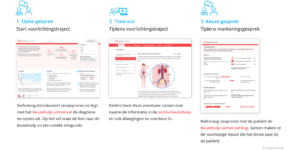

Nurses at Wilhelmina Hospital in Assen made shared decision-making in stroke care a matter of course by structurally integrating the decision aid into the care process, resulting in better-informed and more engaged patients.
Read more
Find out how medical service centres are anticipating developments in healthcare.
Read Altide's story here.For the past six years, Amphia Hospital has been successfully using the Prostate Cancer Decision Aid. At Amphia, oncology nurses Silvie Brock and Saskia Nieuwenbroek coordinate and hand out the Decision Aid. Five years after the first best practice interview, we spoke to them again to hear what has changed since then and how the Decision Aid adds value to shared decision-making in their daily work.
Handing out the Prostate Cancer Decision Aid has now become a fixed part of the routine. Saskia talks about what happens when they introduce it: ‘Silvie and I hand out the Decision Aid at the moment when a patient is facing a choice about their treatment. When we give it to them, we immediately explain what the Decision Aid is.’
According to Silvie, ‘We explain how the Decision Aid works, what information it contains and which treatments they may be eligible for. We also go through the practical side: how to access the website and how to log in. We guide the patient through it all step by step.’
According to Saskia, it is important to have someone in the team who is responsible for handing out the Decision Aid: ‘Agree clearly on who is responsible for giving patients the Decision Aid, so you’re not all assuming someone else will do it. We’ve organised it in the most logical way: we see most of the patients, and everyone knows that we are the ones who hand it out. That works well for us.’ ‘In principle, we give it to every patient. We’ve also added a smart phrase in the EHR that records that the Decision Aid has been handed out. At the start this was a useful reminder – now it’s fully embedded in our routine.’
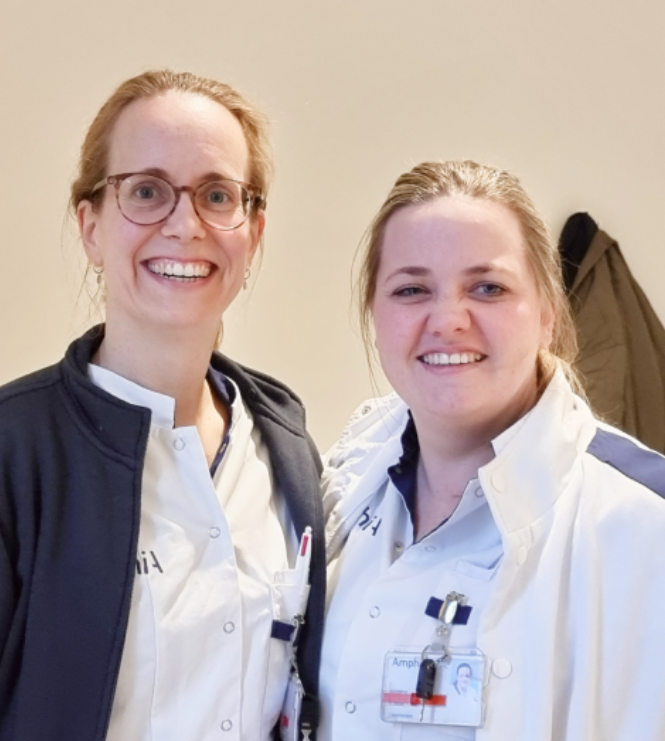
Saskia Nieuwenbroek and Silvie Brock
At Amphia, they see that using the Decision Aid genuinely supports patients in making their choice. ‘The Decision Aid really adds value and is a very useful tool for patients. It helps them make a well-thought-out decision,’ says Silvie.
According to Saskia, ‘Patients appreciate being able to go through the information in a different way, and it also helps family and friends at home stay informed about the options. The information is reliable and complements what we discuss in the consulting room. It offers great support in finding out which option suits them best.’
Especially when someone is very unsure, the Decision Aid can really help them get started. It puts the patient in the lead, encouraging them to think carefully about what suits them best.
– Silvie Brock, oncology nurse
The Decision Aid is often given to patients as “homework”. ‘Especially when patients are still keeping all options open. I always advise my patients to log in to the online Decision Aid and take a look at what it offers,’ says Silvie.
According to Silvie, ‘We always ask whether patients have completed the Decision Aid. ‘Especially when someone is very unsure, the Decision Aid can really help them get started. It puts the patient in the lead, encouraging them to think carefully about what suits them best.’ Some patients find it very difficult to make that choice – they would rather hear from their healthcare professional: “This is what we’re going to do.” The Decision Aid is a very useful tool for making that choice together, and it doesn’t take any extra time either. It actually ends up saving time, because patients can work on it at home.’
I expect shared decision-making will only become more important. Patients are much more actively involved in the decision process now, which makes using a Decision Aid even more valuable.
– Saskia Nieuwenbroek, oncology nurse
In the six years that the Prostate Cancer Decision Aid has been in use, they have noticed a change in patient engagement at Amphia. According to Saskia, ‘There is so much information available to patients, with Google becoming more and more of a companion for everyone. People are much more aware that there are choices to be made, and that’s a real difference compared to five years ago. ‘I expect shared decision-making will only become more important. Patients are far more actively involved in the decision process, which makes a Decision Aid all the more valuable. It helps them compare the options properly and weigh up what really matters to them.’
The Prostate Cancer Decision Aid is intended for men with localised prostate cancer at low or intermediate risk, for whom at least two of the following treatments are possible:
The Decision Aid is also suitable for men with high-risk localised prostate cancer who are choosing between surgery and radiotherapy.
Are you a urologist, medical oncologist or nurse and feel inspired to experience the benefits of this Decision Aid for yourself? In all teams, use of the Decision Aid has become routine within 3 to 6 months.
Would you like to introduce the Prostate Cancer Decision Aid in your hospital? Or are you curious about how the Decision Aid could support your organisation? Feel free to contact us! We’d be happy to tell you more.
Contact us
ZorgKeuzeLab has been part of Enovation since February 2025.
Nurses at Wilhelmina Hospital in Assen made shared decision-making in stroke care a matter of course by structurally integrating the decision aid into the care process, resulting in better-informed and more engaged patients.
Read more
The Kidney Failure Decision Aid supports patients and healthcare professionals in making joint decisions about transplantation, dialysis or conservative treatment by providing insight into outcomes and personal preferences.
Read more