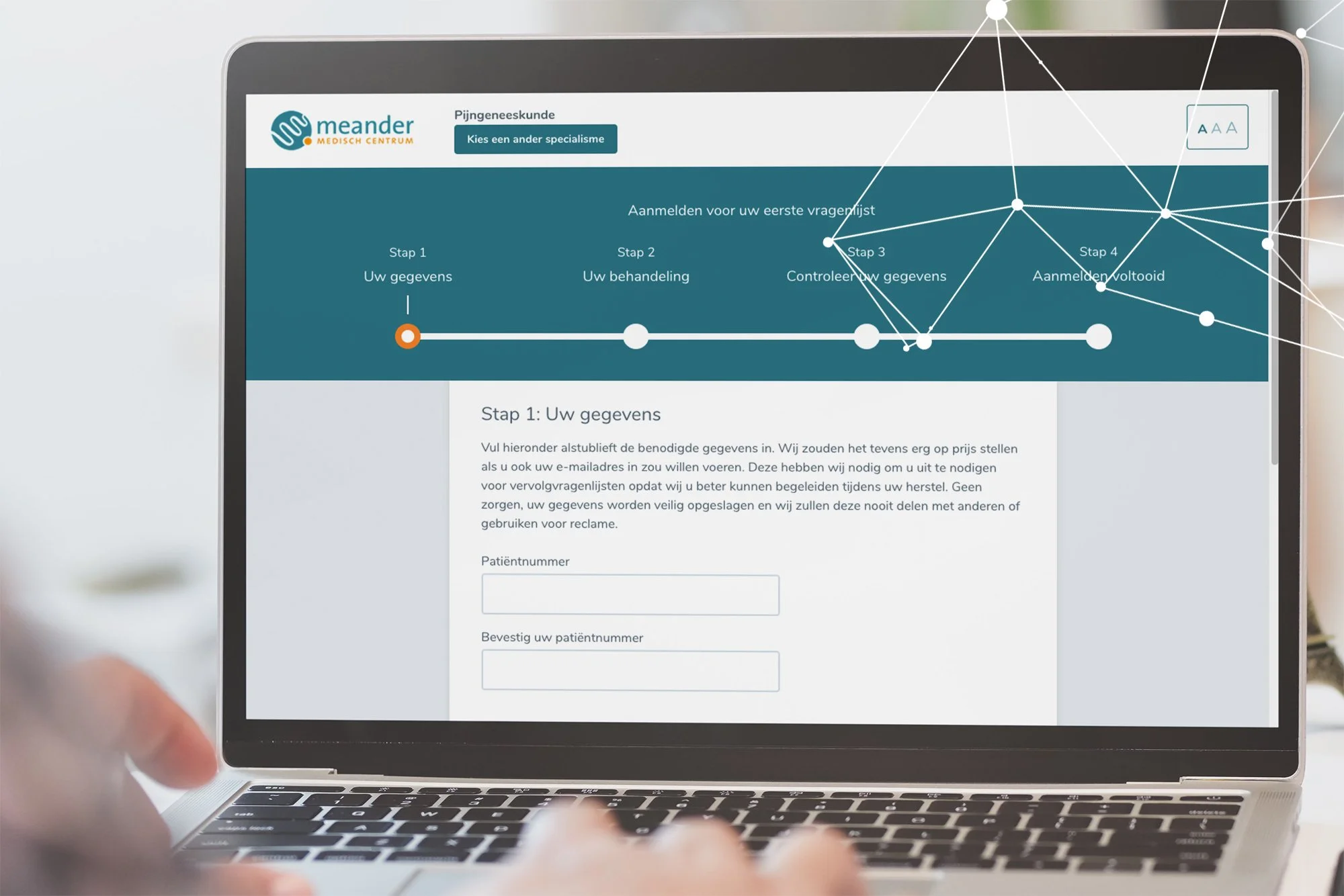
PROMs as a driver of value-based care at Meander Medisch Centrum
Meander Medisch Centrum has been using OnlinePROMS to measure PROMs since 2015. Currently, more than ten departments use the platform. The data is used in various ways and multiple links with the EPR have been established.
Tamara Broughton is a quality and safety adviser at Meander Medisch Centrum. In her role, she has a particular focus on outcome-based improvement. She is also conducting doctoral research at Erasmus MC into the opportunities that value-driven care offers healthcare providers to learn and improve.
In what ways are PROMs part of your work?
At Meander, we have been collecting PROMs through OnlinePROMS for many years. We began doing so in 2015 within Orthopaedics, and Ophthalmology and Urology soon followed. We now measure outcomes in more than ten specialties, with recent additions including Paediatric Diabetes, Pulmonary Medicine and Rehabilitation. When a speciality wants to start collecting data, I engage with them to explore how we can best approach it, so that it aligns well with the existing work process. In this, we obviously look at the specific treatment process, but we also draw on best practices from both Meander and other centres.
How is the data used?
The data we collect is used in various ways. We can use it to monitor an individual patient or, conversely, to see the effect of a treatment at group level. At Meander, we also work with what we call ‘quality tables’: within these multidisciplinary teams, we use the collected data to analyse how we are performing and how we might improve. In that process, we use dashboards that combine PROMs and clinical data. Of course, we also use the data we collected for submission to national registrations of the departments, for scientific research and the annual indicator sets.
Link with the EPR
At our hospital, we actually link to PROMs (also known as OnlinePROMS) in three different ways. First, we use the web viewers, which allow us to view the collected data directly in the EPR. In addition, for patients undergoing surgery, we use a link that automatically creates patients in the system, reducing the amount of administrative work required. Finally, PROMs data is also delivered daily to our data warehouse, allowing us to combine patient-reported outcomes with clinical data for use in quality tables, among other applications.
At our hospital, we link to PROMs in three ways
Future developments
The challenge for the future will be to do even more with the data, especially within the care process for the individual patient. Its use in the consultation room helps patients understand why they completed the questionnaire. The completed questionnaire can also help healthcare providers make the conversation more personalised.
Visualising the data and making it easier to understand, as you are doing now with the customised reports, further lowers the barrier to using the collected data. You can already see the progression of scores on certain questionnaires, but it’s often unclear what is measured by the questionnaire, what the score range is, and whether a higher score is good or bad. This can be complicated for healthcare providers, and almost impossible for patients. Nice-looking reports with a brief explanation of what is measured using the questionnaire and how to interpret its results will definitely make this easier.
The challenge for the future will be to do even more with the data
About the collaboration
I’m very positive about the collaboration. I appreciate that you’re open to new ideas, and eager to contribute solutions to problems in order to continually expand the platform’s functionalities. You also tend to pick up on these kinds of issues quickly. From your point of view, I also think PROMs will never be finished: there is always room for improvement and new possibilities. That, in turn, makes it enjoyable for me to share my ideas with you, because I know they will be taken seriously.
Jeroen Bosch Hospital applies Patient Journey in Preoperative Screening
The Department of Anesthesiology at Jeroen Bosch Hospital (JBZ) has implemented the Patient Journey to make Preoperative Screening (POS) more efficient. Through the Patient Journey app, patients complete a triage questionnaire and receive guidance throughout the entire process leading up to surgery.
Intelligent Care at LUMC: Headache Monitoring Throughout the Patient Journey
The Leiden University Medical Center (LUMC) uses Patient Journey App to monitor patients with migraine. By filling out their headache diary daily via the app, both the patient and the healthcare provider gain insight into the progression of the condition.
Treant Zorggroep is bridging the gap between data and personalised care through the implementation of PROMs
Treant Zorggroep is implementing PROMs (also known as OnlinePROMS) across the hospital to gain insight into care outcomes, improve processes and enhance patient-centred care.